
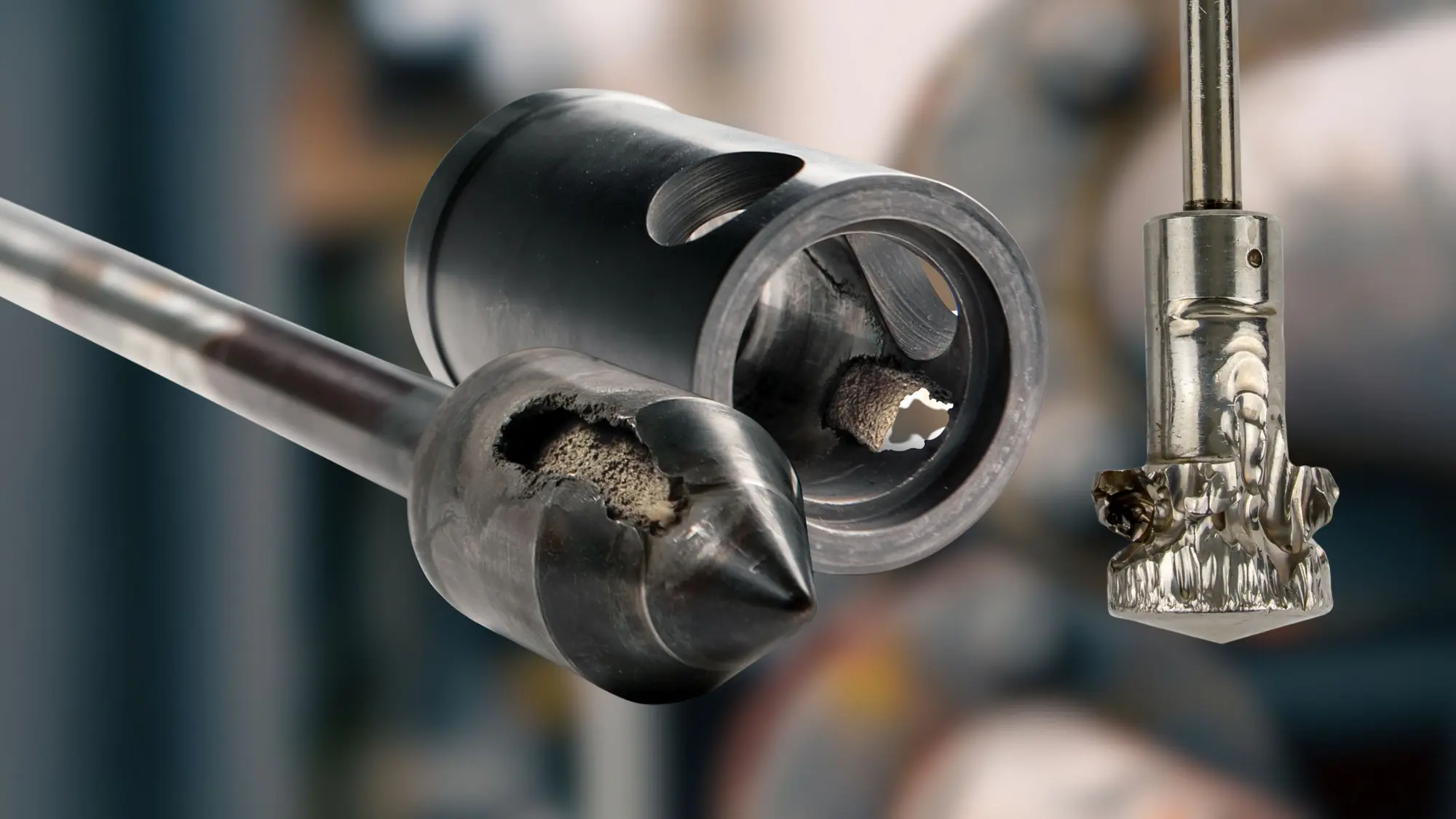
Flashing and cavitation look almost identical on a datasheet and are routinely confused, but they are different phenomena that demand different — sometimes opposite — valve solutions. Getting the diagnosis wrong leads to the wrong trim, and the wrong trim leads to repeated failures that no amount of rebuilding will cure.
The key difference is downstream
Both phenomena start the same way: liquid accelerates through the valve, local pressure falls below vapor pressure, and vapor bubbles form. The difference is what happens after the restriction. In cavitation, the downstream pressure recovers above vapor pressure and the bubbles collapse — that implosion is what destroys the valve internals. In flashing, the downstream pressure stays below vapor pressure, the bubbles do not collapse, and the fluid leaves the valve as a permanent two-phase, liquid-and-vapor mixture.
So the single diagnostic question is whether downstream pressure ends up above or below the fluid's vapor pressure. That one fact decides which problem you have — and therefore which remedy will work.
Different damage, different fix
Cavitation damage is concentrated and internal: imploding bubbles pit the cage, plug and seat. The fix is anti-cavitation trim that stages the pressure drop and keeps local pressure above vapor pressure, or relocates the collapse away from metal surfaces.
Flashing damage is erosive and distributed: a high-velocity two-phase jet scours the valve outlet, the seat area and the downstream piping. Anti-cavitation trim does nothing for it — the answers are hardened, erosion-resistant materials, an expanded or angle-body outlet to slow the mixture, and geometry that keeps the flashing stream off critical sealing surfaces.
Reading the service conditions
Whether a given service flashes or cavitates is set by the system, not the valve: inlet pressure, the pressure the valve must drop to, fluid temperature and vapor pressure together determine the outcome. Proper sizing calculations make this explicit and identify which phenomenon — or which mix of the two across the operating range — the valve will face.
It is common for a valve to cavitate at some conditions and flash at others as flow and pressures move. That is exactly why selection has to be based on the full operating envelope rather than a single design point.
Matching the remedy to the duty
Specifying the wrong remedy wastes capital and leaves the valve failing on a predictable schedule — anti-cavitation trim in a flashing service simply erodes, and erosion-resistant trim in a cavitating service still implodes. The cost of a correct diagnosis is small; the cost of repeatedly rebuilding the wrong solution is not.
Once the right trim and materials are specified, performance depends on rebuilding with genuine, correctly-specified parts. ACD supplies genuine Fisher™ trim so that, once the diagnosis is right, the valve is restored to perform as engineered for its actual service.
Need the genuine part for this?
Send us the serial number, model or spec — genuine Fisher™ parts, fast quotes, shipped from our Orlando, FL warehouse.