
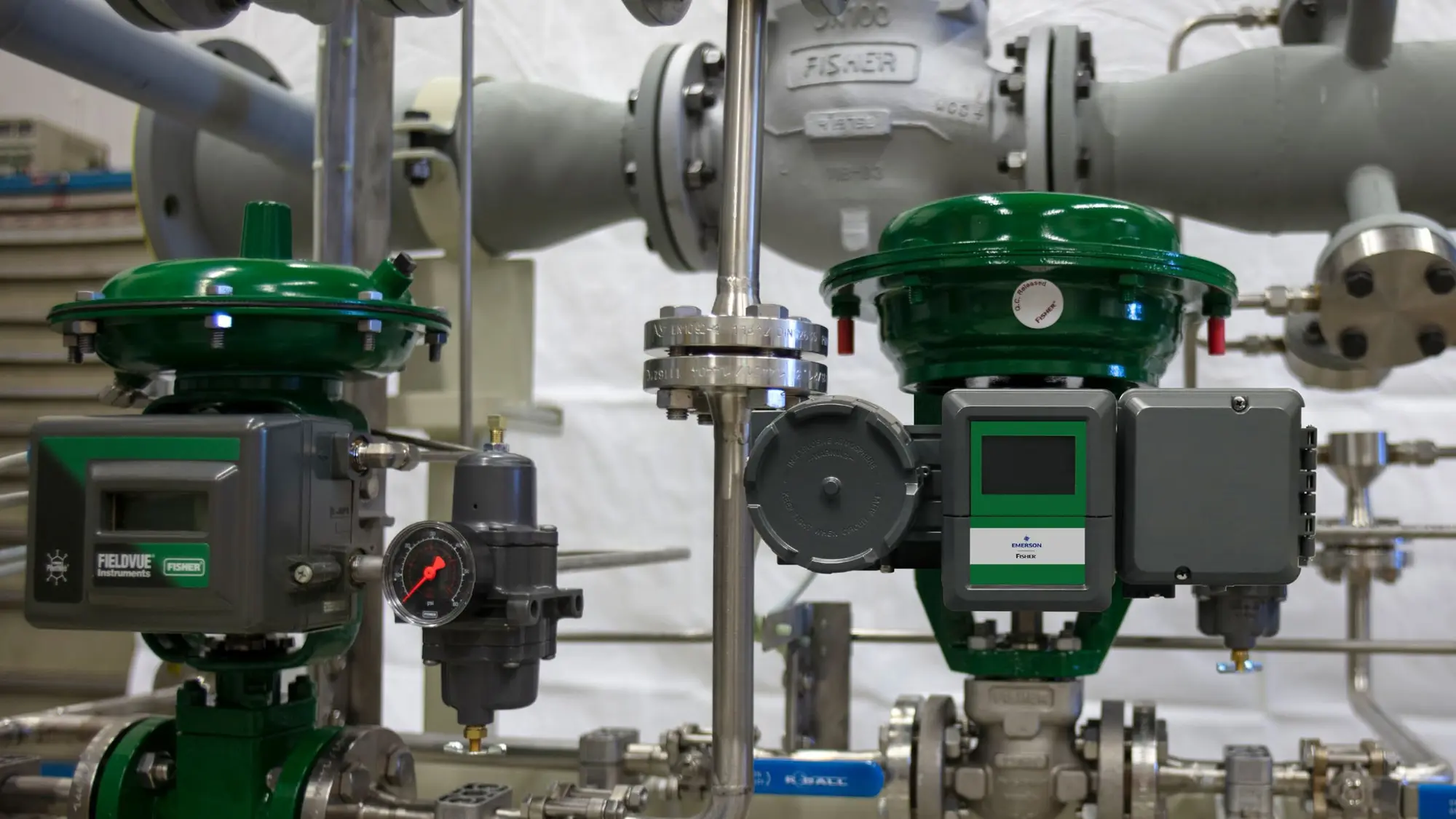
Digital valve controllers (DVCs) have quietly become the default on new and upgraded control valves. They do far more than drive the valve to position — they have turned the final control element into a source of continuous health data. That shift is powerful for reliability, but it also changes the spare-parts picture in ways many plants have not fully absorbed.
From positioner to diagnostic device
A modern DVC such as the Fisher™ FIELDVUE™ family performs the basic job of a positioner — comparing the control signal to actual stem position and modulating actuator pressure to match — but it also continuously watches the valve's signature: travel, drive pressure, friction, supply pressure and cycle counts. Those parameters trend over time, and the trends are leading indicators.
Rising friction points to packing or stem-bushing wear. A shifting travel-versus-drive-pressure relationship can reveal a bench-set drift, a diaphragm problem or seating issues. Read in time, that signature flags a degrading valve long before it sticks, fails to stroke, or trips a unit.
Why it matters for parts
As more valves carry DVCs, the spares conversation broadens. It is no longer only trim and packing; it now includes positioners, electronic modules, terminal boxes, pneumatic relays and feedback assemblies. An instrumented valve has two failure domains — mechanical and electronic — and a complete strategy has to cover both.
That also means knowing the firmware and hardware generation of each installed controller, because not every module is interchangeable across versions. The valve body may be perfectly healthy while the loop is down for want of a matching electronic component.
The availability gap
Electronic spares frequently carry longer lead times than mechanical parts, and they are easier to overlook in a traditional stores system organized around trim kits and gaskets. The combination is a classic availability gap: the diagnostics warn of a problem, but the part that would fix it is weeks away.
Plants that close the gap map which valves are instrumented, record the exact controller variant on each, and stock the matching genuine components for the critical loops. The diagnostics then deliver their full value — early warning paired with the means to act on it.
Building the electronic-spares plan
A workable approach mirrors how plants already handle mechanical spares: rank instrumented valves by the consequence of their failure, confirm the genuine module and feedback parts for the high-consequence loops, and verify availability before the next turnaround rather than after a trip.
ACD supplies genuine Fisher™ parts across both domains — trim and packing as well as positioner and module spares — so an instrumented valve is repaired as one system and is not sidelined with a healthy body waiting on a controller.
Need the genuine part for this?
Send us the serial number, model or spec — genuine Fisher™ parts, fast quotes, shipped from our Orlando, FL warehouse.