
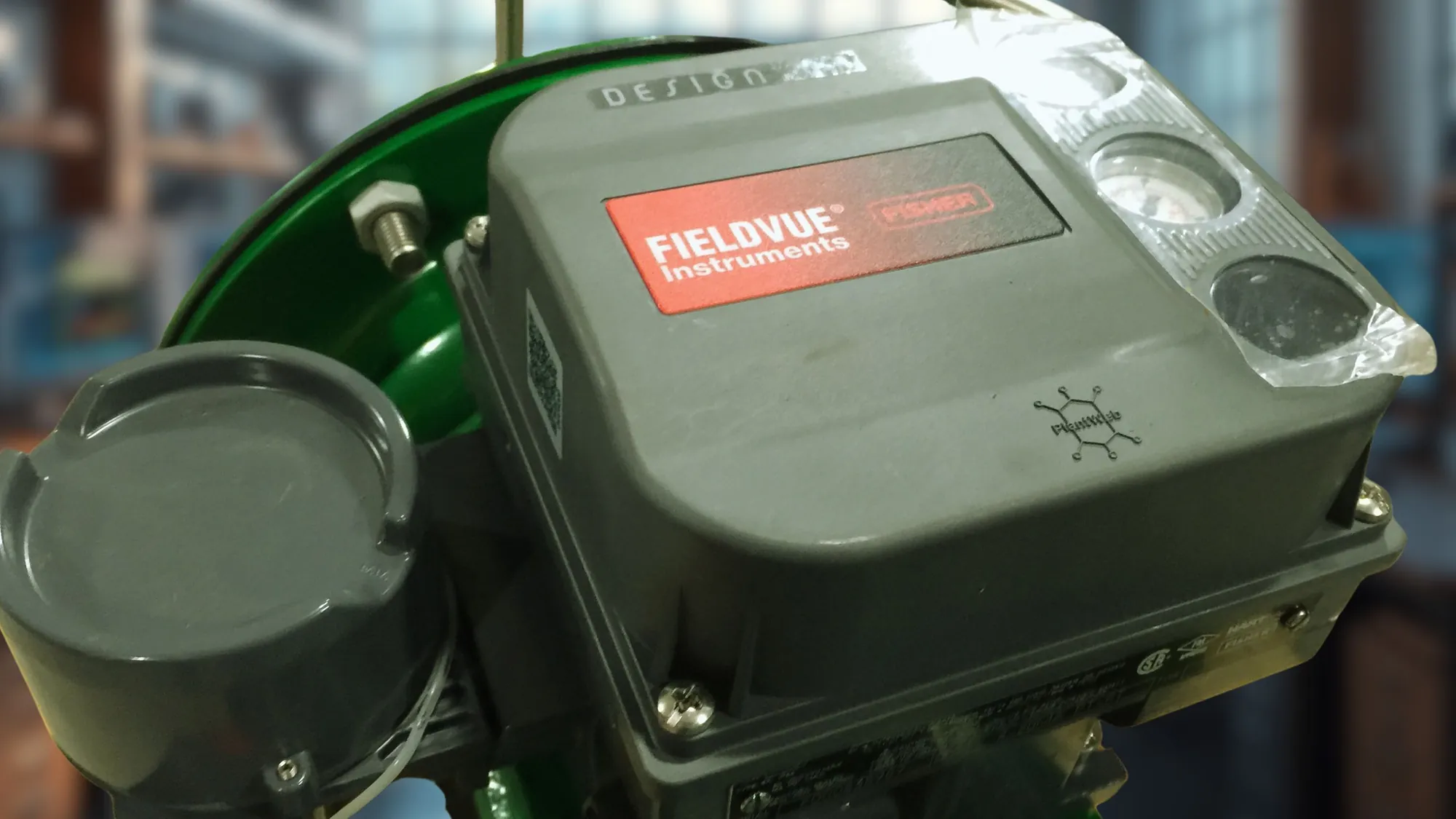
The Fisher™ FIELDVUE™ DVC7K is the most recent generation of digital valve controller in the FIELDVUE™ line — the device that sits on a control valve, drives it to position, and increasingly defines how reliably that valve performs over its life. A digital valve controller does far more than a traditional positioner: it turns the final control element into a continuous source of valve-health information. For the plants ACD America serves, understanding what a controller like the DVC7K actually contributes — and what it means for the parts and documentation behind it — is the difference between owning the technology and getting the full value out of it.
What a digital valve controller is
At its most basic, a digital valve controller is a positioner: it compares the control signal coming from the system to the actual position of the valve stem, and modulates the actuator pressure until the two match. That much a pneumatic or analog positioner has always done. What makes a device like the Fisher™ FIELDVUE™ DVC7K different is that it does this job digitally and, while doing it, continuously measures and records what the valve is doing — travel, drive pressure, supply pressure, friction and cycle activity among them.
That instrumentation is the shift. The valve is no longer a silent mechanical device that only reveals its condition when it sticks or leaks; it becomes a data source that can be read, trended and acted on. The DVC7K is Fisher™'s latest expression of that idea in the FIELDVUE™ family, carrying the digital-positioner-plus-diagnostics concept forward into current installations and upgrades.
What it adds over earlier generations
Earlier positioners told you, at best, that the valve was roughly where it was asked to be. A modern FIELDVUE™ controller goes much further: it builds a health signature of the valve from the parameters it watches, and those parameters trend over time into leading indicators of trouble. Rising stem friction points toward packing or bushing wear; a drifting relationship between travel and drive pressure can flag a bench-set shift, a diaphragm issue or a seating problem — each visible in the data well before it becomes a stuck valve or a failed stroke.
The practical advance the DVC7K generation represents is making that diagnostic capability the expected baseline rather than a premium add-on. A valve carrying a current-generation digital controller is one whose condition can be assessed without pulling it from service, which is precisely what lets maintenance move from calendar-based to condition-based. The exact feature set and specifications are defined by Emerson's published documentation for the device; the point that matters for reliability is the category — current-generation digital control with built-in diagnostics — not a spec sheet recited from memory.
Why it matters for reliability
The reliability payoff comes from reading the valve's signature in time. A controller that flags a degrading valve weeks before it would have failed converts a surprise outage into a planned repair — work scheduled into a maintenance window, with the right people and the right parts staged, instead of an emergency call-out that stops a unit mid-run. That early warning is the whole reason instrumented valves earn their place on critical loops.
But the warning only delivers if the plant can act on it, and that is where an instrumented valve quietly changes the spares picture. A valve with a DVC7K has two failure domains, not one: the mechanical body — trim, seats, packing — and the electronic side — the controller itself, its modules and feedback components. A complete reliability strategy has to cover both, because a perfectly healthy valve body is no use if the loop is down waiting on a matching electronic part. Knowing the exact controller generation installed on each critical valve is part of that discipline, since not every module is interchangeable across versions.
Sourcing, documentation and support from ACD
For the operators ACD America supplies, the DVC7K fits a pattern the aftermarket has been absorbing for years: as digital valve controllers become the default, the parts conversation widens from trim and packing to include positioners, electronic modules and feedback assemblies — and electronic spares often carry longer lead times than mechanical ones. Mapping which valves are instrumented, recording the exact controller variant on each, and confirming the genuine components for the high-consequence loops is how plants close that availability gap and let the diagnostics pay off.
ACD America supplies genuine Fisher™ valve positioners and digital valve controllers, including the FIELDVUE™ line, as an independent distributor of Fisher™ products — and backs that supply with application-engineering support and a Technical Library of Fisher™ product documentation so you can confirm the right device and the right spares against your installation. Send us the valve, the installed controller and the service, and our application engineers will help match the genuine positioner, module or feedback parts the loop needs — so the valve is maintained as one system, mechanical and electronic together.
Need the genuine part for this?
Send us the serial number, model or spec — genuine Fisher™ parts, fast quotes, shipped from our Orlando, FL warehouse.