


» Fisher™ · Control Valves
Three-Way Control Valves
Three-way globe valves for converging (blending) or diverging (diverting) service — one valve body that mixes or splits flow for thermal and blending control.
- Sliding-stem · 3 ports
- Converging (mix) or diverging (split)
- Balanced or unbalanced trim
- Shares easy-e™ parts
What it is
Three-Way Control Valves
A three-way control valve is a globe (sliding-stem) valve with three pipeline connections instead of two. A single cylindrical plug proportions flow between the ports — combining two streams into one (converging / flow-mixing) or splitting one stream into two (diverging / flow-splitting) — which makes it the natural choice for blending and thermal control such as heat-exchanger bypass and temperature mixing.
Plug position sets the split. At mid-travel the common port opens to both of the other ports; as the plug strokes, flow shifts from one path to the other. Variations include cage-, port- and stem-guided designs, and standard end connections — flanged, screwed or butt-weld — mate the valve to almost any piping scheme, including high-temperature service.
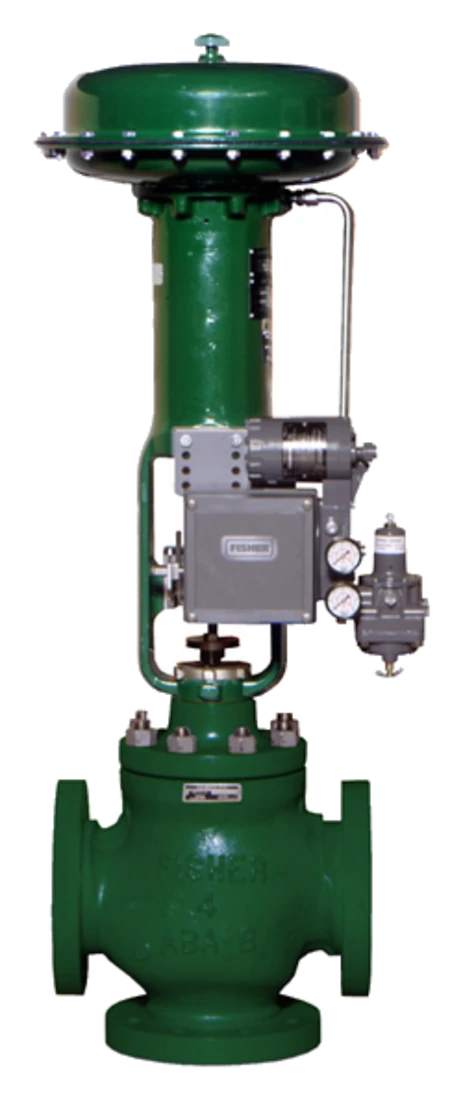
The Fisher™ YD and YS are the cage-guided three-way valves of the line: the YD for general converging and diverging service, the YS for converging service, in balanced or unbalanced constructions. A balanced plug lets the valve run with a smaller, lower-cost actuator, and because they share Fisher™ easy-e™ bonnets, gaskets and packing, they cut spare-parts inventory.
How it works
Construction & trim
Actuator selection deserves care — especially with an unbalanced plug — because the flow forces change as the plug proportions between ports. Balanced cage-guided trim cancels most of that force, so the YD can run with a smaller actuator than an equivalent unbalanced three-way.
Whether the valve is plumbed to converge or diverge is set by the piping and the plug action; the same body and trim platform covers both modes. Matching the construction (cage-, port- or stem-guided), trim and materials to the service — and to the temperature — is what sets control quality and life.
Fisher™ YD (converging & diverging)
Cage-guided three-way for general converging and diverging service, balanced or unbalanced, on a one-piece body that uses easy-e™ bonnets, gaskets and packing.
Fisher™ YS (converging)
Cage-guided three-way for converging (flow-mixing) service — shares the easy-e™ parts platform to cut spare inventory.
Balanced or unbalanced trim
A balanced plug cancels most flow force, permitting a smaller, lower-cost actuator; unbalanced trim where shutoff needs it.
Cage-, port- or stem-guided
Guiding options with flanged, screwed or butt-weld ends to suit high-temperature service and most piping schemes.
Common applications
Where three-way control valves fit
- Converging (blending) service — combining two streams into one controlled flow
- Diverging (diverting) service — splitting one stream into two paths
- Heat-exchanger bypass and temperature mixing for thermal control
- High-temperature duties suited to cage- or stem-guided constructions
- Blending loops where one three-way valve replaces two two-way valves
Why it's chosen
- One valve handles mixing or diverting — fewer valves and fittings in the loop
- Balanced trim allows smaller, lower-cost actuators
- Shares Fisher™ easy-e™ bonnets, gaskets and packing — lower spare-parts inventory
- Cage/port/stem-guided options and end connections for most piping and high temperatures
Worth weighing
- Actuator sizing is critical with unbalanced plugs as flow forces shift between ports
- For simple two-way throttling a standard globe valve is simpler and lower cost
Genuine OEM
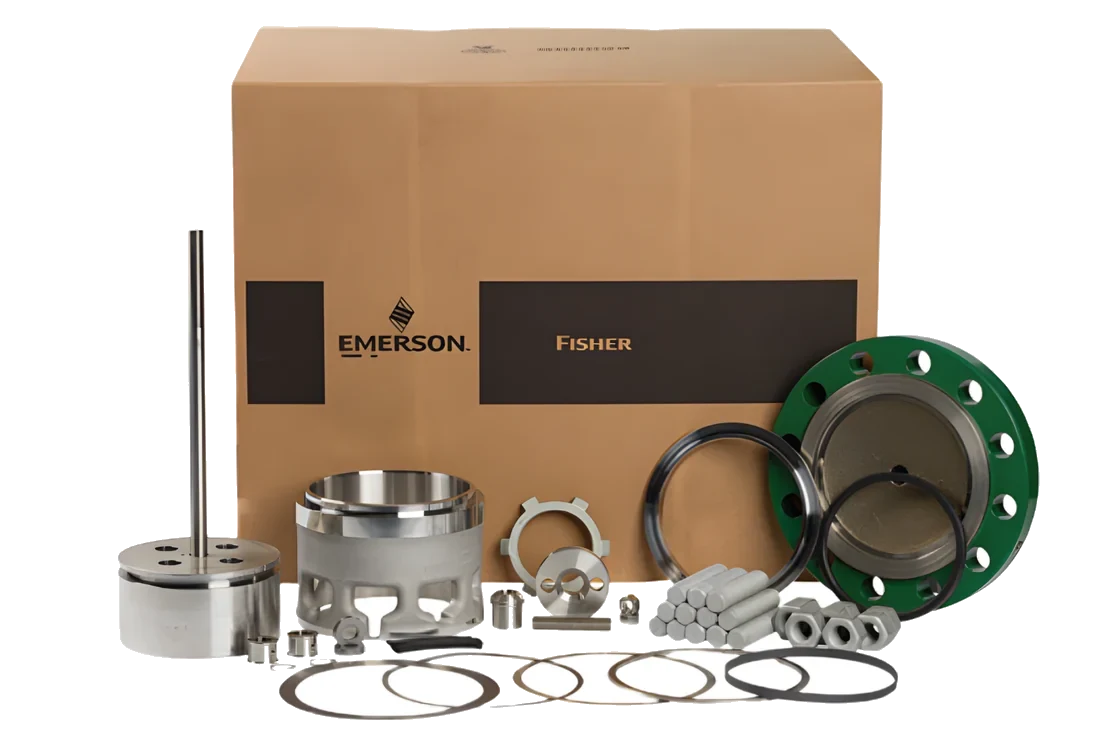
Genuine spare parts for three-way control valves
Cylindrical plugs, cages, seat rings, easy-e™ bonnets, gaskets and packing — the genuine OEM internals (shared across the easy-e™ platform) that keep a three-way valve proportioning and sealing as designed, with minimal spare-parts inventory.
A will-fit look-alike can quietly undermine control, shutoff and emissions compliance — genuine OEM parts protect the design the valve was built to.
Resources & tools
Size it, look it up, learn the engineering
The guides and free tools behind every three-way control valves decision — from sizing to finding the replacement for a discontinued unit.
Sizing guide
How to Size a Control Valve
A practical, step-by-step walkthrough of valve sizing and selection — service conditions, Cv, pressure drop, characteristic and severe-service checks. Grounded in the Fisher™ Control Valve Handbook.
Read the guide →Download
Fisher™ Sliding-Stem Valve Selection Guide (PDF)
Fisher™ selection guide — body styles, sizes, materials and trim to match the valve to your service.
Download PDF →Free tool
Valve Flow & Cv/Kv Calculator
Estimate flow, pressure drop or the required flow coefficient for liquids, gas and steam. Open the calculator and unlock it on its page.
Open the calculator →Free tool
Fisher™ Obsolete & Inactive Lookup
Running a discontinued Fisher™ valve, actuator or instrument? Find its recommended replacement, then ask us about genuine OEM spare parts.
Look it up →Technical library
Handbooks & application guides
The Fisher™ Control Valve Handbook and our application guides — the reference material behind every sizing and selection decision.
Browse the library →Control Insights
Engineering articles
Cavitation, flashing, characterization, digital valve diagnostics and more — practical control-valve engineering from our team.
Read Control Insights →Send us a serial number, model or service and our team will identify and quote the right Fisher™ three-way control valve or parts.
Need three-way control valves or parts?
Send us the serial number or model — genuine OEM, shipped from our Orlando, FL warehouse.