


» Fisher™ · Control Valves
Angle Valves
Sliding-stem control with a 90° change of direction — built for high-pressure, erosive and flashing service, and for piping where the valve doubles as an elbow.
- Sliding-stem · 90° flow path
- Inlet ⊥ outlet ports
- Ratings to Class 2500 / API 10,000
- Expanded outlets for erosion control
What it is
Angle Valves
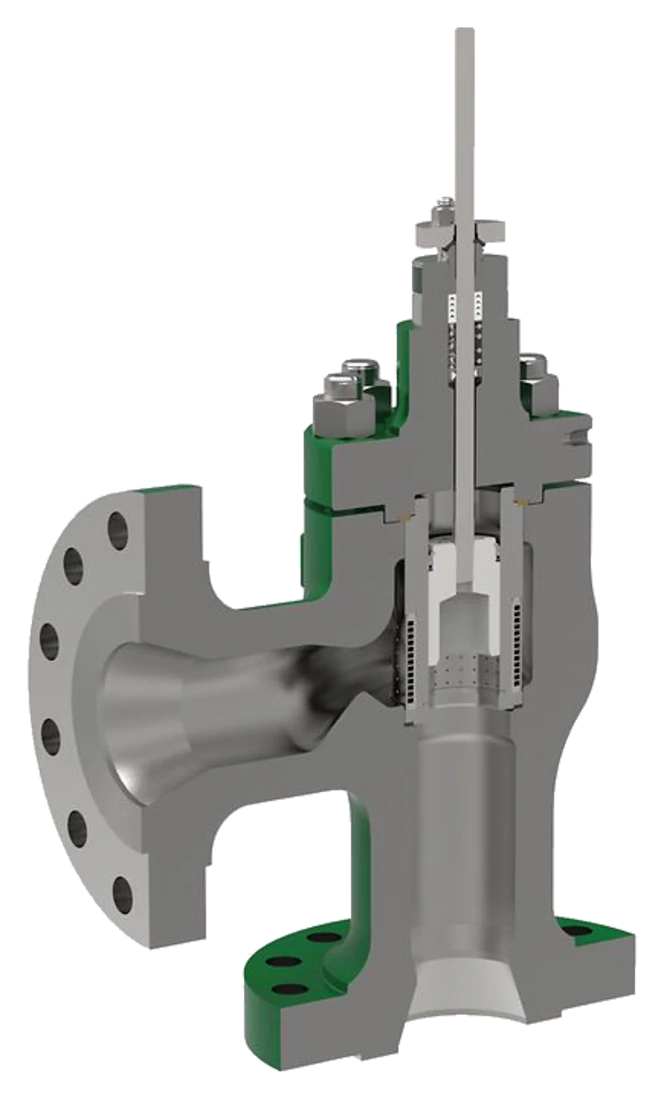
An angle control valve is a sliding-stem valve whose inlet and outlet ports sit perpendicular to each other, turning the flow through 90°. It is, in effect, a globe valve built into an elbow: the same linear plug-and-seat throttling, packaged so the valve changes the direction of the line at the same time as it controls the flow.
That geometry does real work. In tight piping it saves space, material and installation time by serving as both the control valve and the elbow. And because the flow makes a single, clean directional change with few impacts, the angle body is a traditional answer for erosive and flashing service — especially when the outlet is expanded to slow the fluid downstream of the throttling point.
Angle valves share the globe valve's trim flexibility — cage- or post-guided, balanced or unbalanced — so the same body can be characterized, fitted with restricted trim, or lined for erosion, flashing and cavitation resistance. High-pressure stem-guided versions, with threaded bonnets and self-draining bodies, are common in oil and gas production.
How it works
Construction & trim
Most angle bodies use the same constructions as globe valves: single-seated post-guided trim for stringent shutoff, or cage-guided trim — balanced or unbalanced — that retains the seat ring, guides the plug and sets the flow characteristic. The 90° body simply routes the flow through the seat and out the perpendicular port.
For erosive and flashing duties the key features sit downstream of the throttle: expanded outlet connections and outlet liners drop the velocity and keep the high-energy stream off critical surfaces, while hard trim materials resist the wear that remains. Choosing the right guiding, trim and materials for the service is what sets control accuracy, shutoff and service life.
Cage-guided (balanced/unbalanced)
Cage trim retains the seat ring, guides the plug and sets the flow characteristic; balanced trim cancels most unbalanced force, allowing smaller actuators.
Post- & port-guided
Single-seated trim with metal-to-metal or soft seating for stringent shutoff requirements — most common in the smaller sizes.
Expanded outlet / lined
Expanded outlet connections, restricted trim and outlet liners reduce erosion, flashing and cavitation damage by slowing the downstream stream.
High-pressure stem-guided
Threaded-bonnet, self-draining angle bodies for oil and gas production, with flanged versions rated to Class 2500 and high-pressure designs beyond.
Common applications
Where angle valves fit
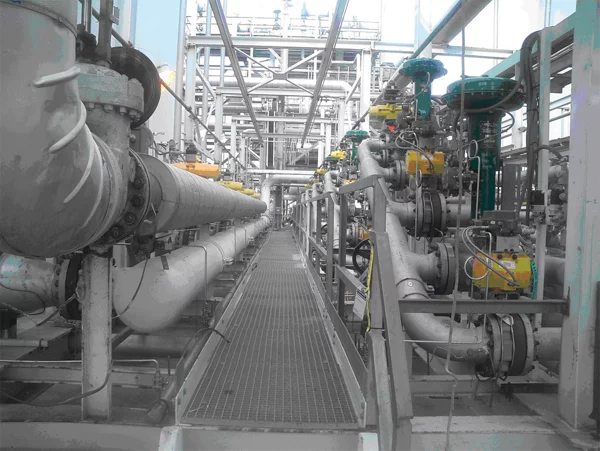
- Boiler feedwater and heater drain service — a classic angle-valve duty
- Erosive, flashing and cavitating liquids, where the expanded outlet and single 90° turn reduce wear
- High-pressure oil and gas production, including dump valves, scrubbers and separators
- Tight piping schemes where the valve doubles as an elbow to save space and installation time
- Steam let-down and turbine-bypass duties when paired with noise-abatement trim
Why it's chosen
- A single 90° flow path with few impacts — inherently kinder to erosive and flashing service
- Doubles as an elbow, saving space, material and installation time in tight layouts
- Expanded outlets and outlet liners extend life in high-velocity, two-phase flow
- Shares globe-valve trim flexibility — characterization, restricted trim and severe-service options
Worth weighing
- The fixed 90° geometry must suit the piping layout — not a drop-in for straight-through runs
- Like all globe-style valves, lower pressure recovery than rotary designs (with the cavitation-margin benefit that brings)
Genuine OEM
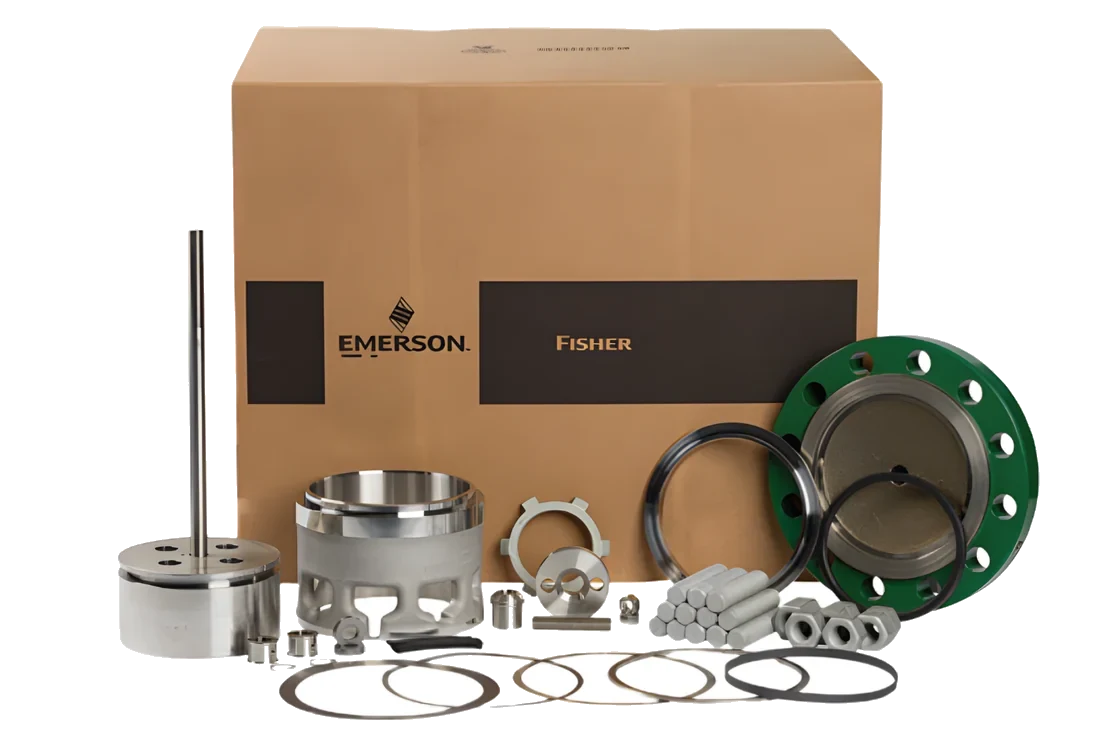
Genuine spare parts for angle valves
Trim sets, cages, seat rings, valve plugs, stems, outlet liners, bonnets, packing and gaskets — the genuine OEM internals that keep an angle valve sealing, characterized and erosion-protected to its original design.
A will-fit look-alike can quietly undermine control, shutoff and emissions compliance — genuine OEM parts protect the design the valve was built to.
Resources & tools
Size it, look it up, learn the engineering
The guides and free tools behind every angle valves decision — from sizing to finding the replacement for a discontinued unit.
Sizing guide
How to Size a Control Valve
A practical, step-by-step walkthrough of valve sizing and selection — service conditions, Cv, pressure drop, characteristic and severe-service checks. Grounded in the Fisher™ Control Valve Handbook.
Read the guide →Download
Fisher™ Sliding-Stem Valve Selection Guide (PDF)
Fisher™ selection guide — body styles, sizes, materials and trim to match the valve to your service.
Download PDF →Free tool
Valve Flow & Cv/Kv Calculator
Estimate flow, pressure drop or the required flow coefficient for liquids, gas and steam. Open the calculator and unlock it on its page.
Open the calculator →Free tool
Fisher™ Obsolete & Inactive Lookup
Running a discontinued Fisher™ valve, actuator or instrument? Find its recommended replacement, then ask us about genuine OEM spare parts.
Look it up →Technical library
Handbooks & application guides
The Fisher™ Control Valve Handbook and our application guides — the reference material behind every sizing and selection decision.
Browse the library →Control Insights
Engineering articles
Cavitation, flashing, characterization, digital valve diagnostics and more — practical control-valve engineering from our team.
Read Control Insights →Send us a serial number, model or service and our team will identify and quote the right Fisher™ angle valve or parts.
Need angle valves or parts?
Send us the serial number or model — genuine OEM, shipped from our Orlando, FL warehouse.